PPCDN — WebRTC CDN / UltraLow Latency Video API
PPCDN delivers 30%–50% bandwidth and cost savings with an end-to-end ultra-low latency (<500 ms) experience:
- Multiple ingest protocols (ERTMP/SRT/WHIP) adapt to different live-site networks while delivering ultra-low latency (including playout buffer):P2P direct: <120 ms; WHIP: <200 ms; ERTMP: <200 ms; SRT: <500 ms
- Multiple technologies combine to reduce traffic and cost by 30%–50%:HEVC simulcast; embedded P2P traversal server; zero network transcoding.
- ABR adapts to each viewer's network for smoother playback.
- An API exposes the current playback frame timestamp to synchronize game results with the audio/video stream.
Advantages over Tencent Cloud Live: 1 s lower average latency; zero transcoding fees for ABR; current playback video timestamp available.
EP12 · Benchmarking low-latency live streaming and the current baseline
A same-caliber way to measure latency, from on-screen timestamps to an automated pipeline, plus PPCDN's current measured baseline (P2P direct ~70ms).
YouTube channel ↗About ppcdn
ppcdn (pp-cdn.org) is a WebRTC CDN Platform and an UltraLow Latency Video API for interactive live streaming: publish with WHIP/SRT via ppobs and play over WHEP with ppplayer. Routing is codec-aware — HEVC-capable clients stream from Edge, while others try P2P direct-connect for H.264 and fall back to Edge when NAT traversal fails or P2P slots are exhausted. It supports up to 4 simulcast layers and HEVC/H264 multitrack.
It offers ABR, video metrics monitoring, a per-session recording API, and a subscribable AI live health report — serving live commerce, online classrooms, interactive games, and 1-on-1 live.
WHIP / SRT Simulcast Ingest
Publish over WHIP or SRT as simulcast, with up to 4 layers. Layers switch seamlessly and step up/down automatically by packet loss to keep the stream smooth.
HEVC / H264 Multitrack
Optionally publish H264 and HEVC as two independent simulcast streams; HEVC-capable clients pull HEVC-simulcast for ~30% less traffic, others pull H264-simulcast.
ABR Adaptive Bitrate
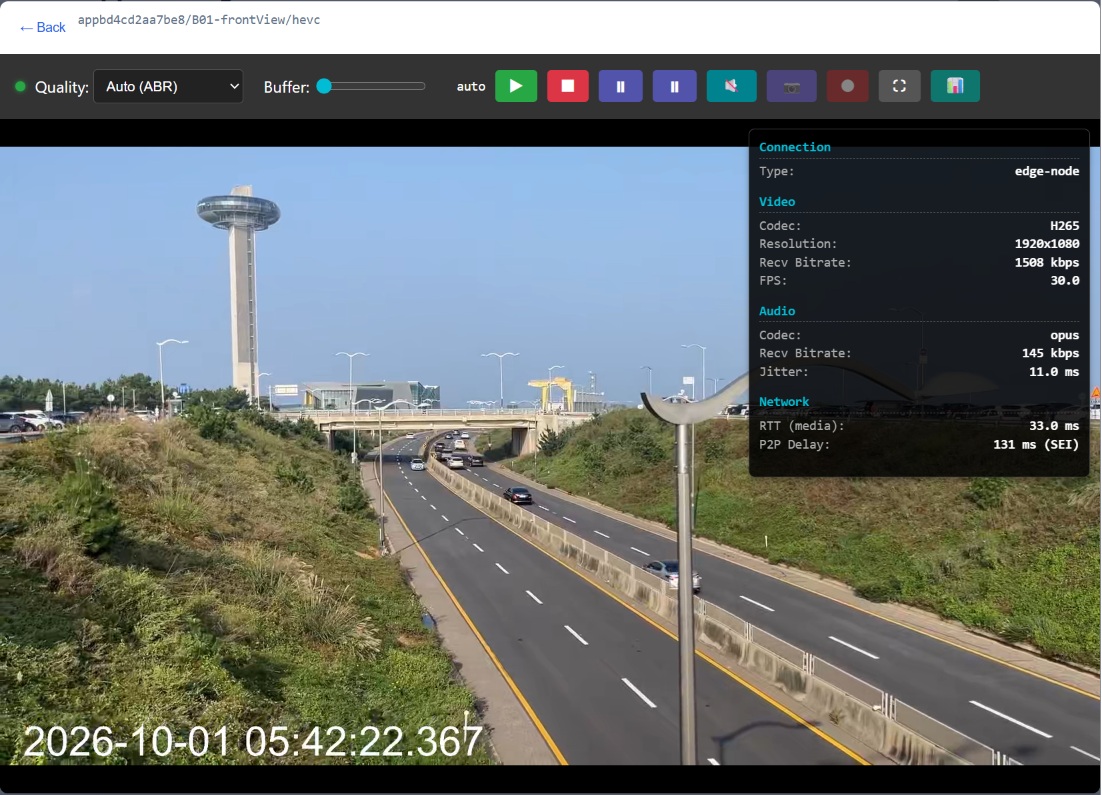
The ppplayer supports an ABR adaptive streaming protocol, picking a suitable quality to play. Manual switching between quality levels is also supported, with no black screen.
NAT-Traversal Live
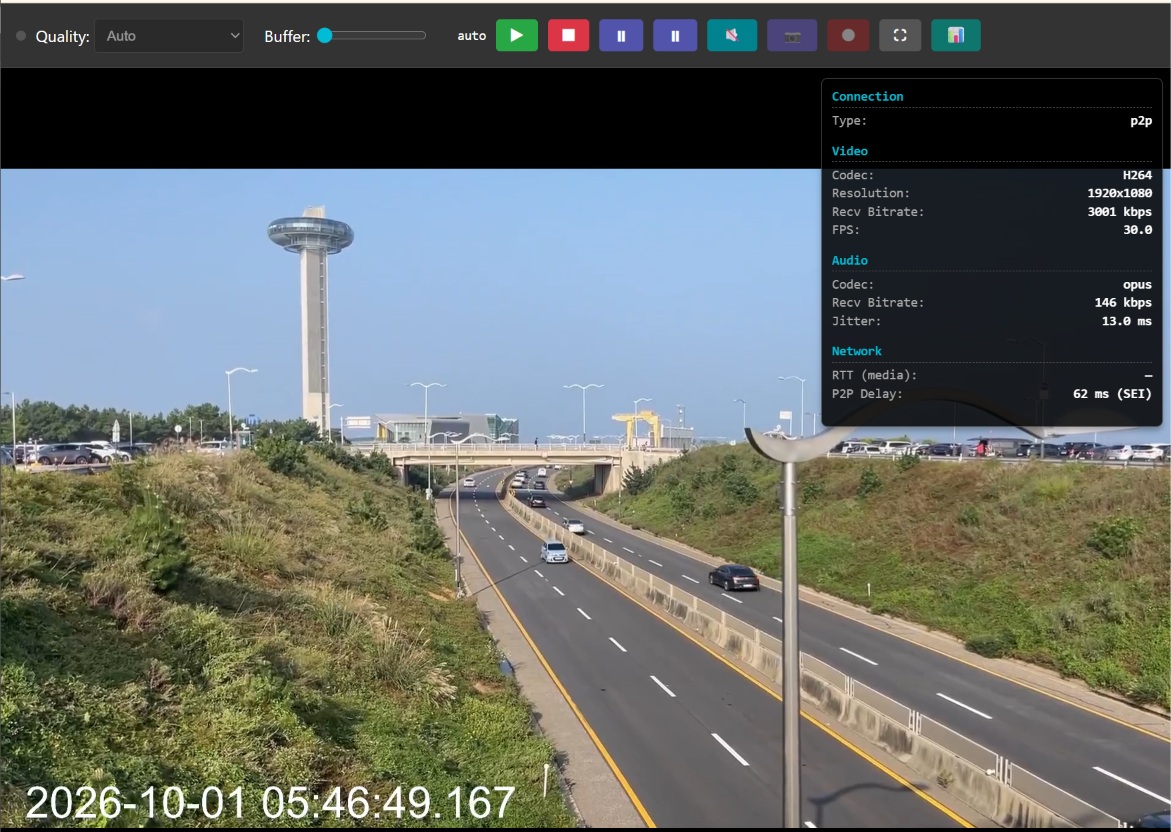
Clients without HEVC first try a direct P2P connection to the publisher over NAT traversal for H.264, with end-to-end latency as low as 60ms — ideal for 1-on-1 scenarios like iSOT. It falls back to Edge H.264 when the direct connection fails or the 3 P2P slots are exhausted. HEVC-capable clients stream from Edge.
SEI Real-Time Timestamp
After NTP clock sync, ppobs stamps a timestamp into the live media; ppplayer parses it to compute the P2P delay. ppplayer syncs its clock via ppcenter's NTP.
Video Metrics Monitoring
The console monitors pull success rate, video load time and stream stalling rate. P2P delay targets: P80 ≤300ms, P99 ≤2s; load time <1s; stalling rate <2%.
Per-Session Recording API
Two calls (session start/end) split exact recording files, upload them to object storage and return playback URLs; retention up to 90 days. Works for a game round, an auction, or a class alike.
AI Live Health Report
Subscribe to an account-level video health report covering traffic, publishing, uplink loss, playback latency and viewer geo. Subscribers get managed video operations.
Use Cases
Live Video Interaction
Real hosts on camera with near-synchronous viewing — for scenarios that need an instant response.
Real-Time Trading
Auctions, quotes and flash sales where bid and picture must not drift apart.
Live Classroom
Teacher and students interact in real time; low latency keeps Q&A, voice and whiteboard in sync, and each lesson can be recorded per session.
Interactive Game Streaming
Viewers take part live with chat and voice; low latency, minimal stutter, adaptive quality layers.
pplayer Live Demo
Below is a generic demo URL. Sign up and create an app to get your own personalized stream URL.
Contact & feedback
Register or log in, then talk to the official team in Console → Messages. We reply only through in-app messages.
ppcdn Footprint
A record of key capabilities as we build the low-latency real-time video infrastructure.
Public launch / First milestone
- SRT / WHIP / ERTMP simulcast ingest with H264 and HEVC
- P2P direct connect + Edge ABR playback
- SEI absolute timestamp (TS) transport with automatic latency calculation
ERTSP protocol support
Simplified ingest and viewing for embedded devices.
Simultaneous main and H5 stream publishing
ppobs publishes the main stream and an H5 stream at the same time; the H5 stream is cropped from the main stream.